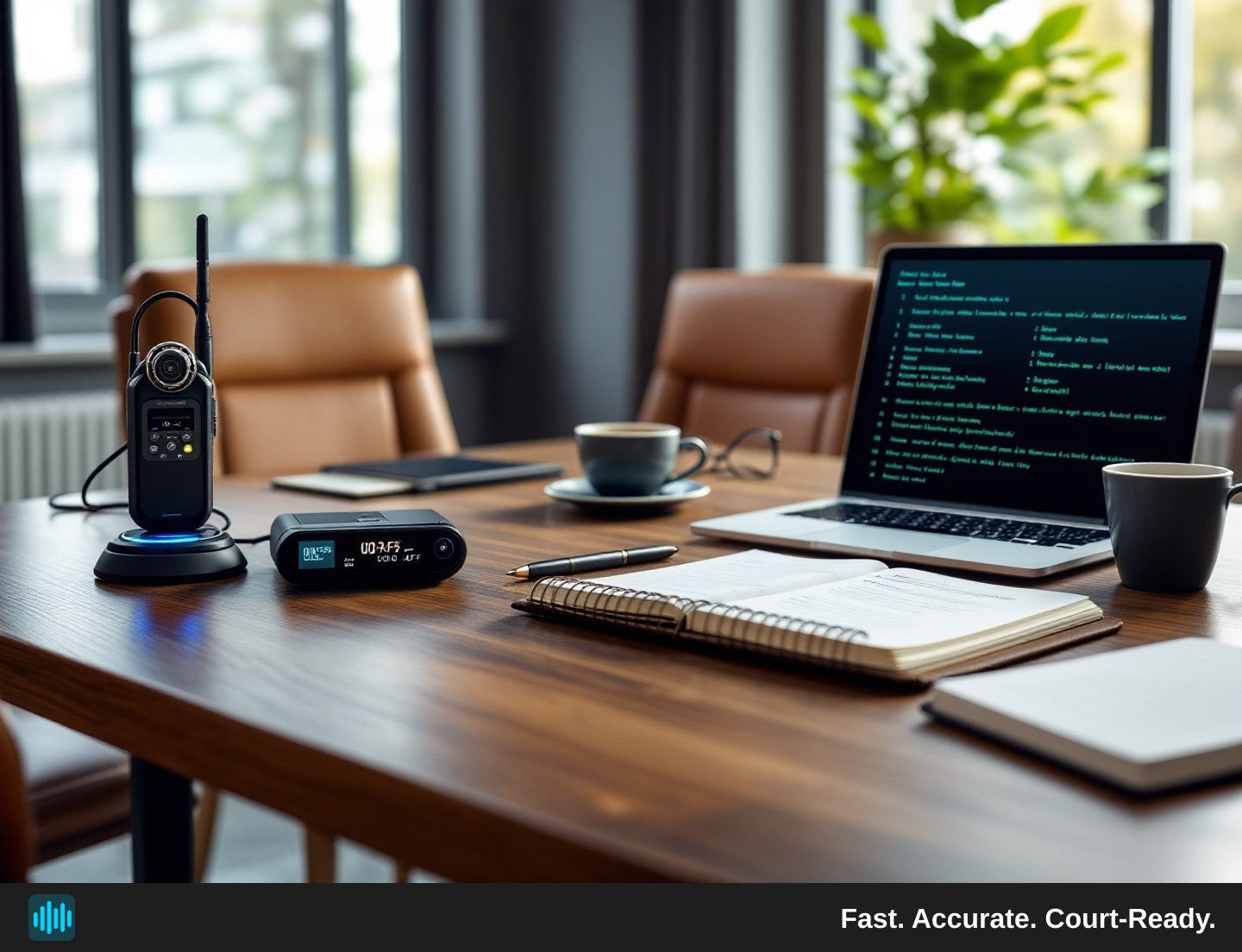
Foreign-language depositions sit at the intersection of two demanding disciplines: legal accuracy and linguistic precision. When a witness testifies through an interpreter, every spoken word — in both the source language and the English interpretation — carries potential evidentiary weight. A transcript that muddles the two, misattributes a speaker, or silently drops an interpreter's clarification can undermine a case long before it reaches the courtroom.
This guide walks litigation attorneys, court reporters, and legal secretaries through a practical workflow for transcribing foreign-language depositions with the level of accuracy the record demands.
Why Foreign-Language Depositions Are Harder to Transcribe
On the surface, a bilingual deposition looks like any other recorded proceeding: multiple speakers, a structured Q&A format, and a reporter capturing the record. In practice, the transcript must do far more work.
The Dual-Channel Problem
Most interpreted depositions involve at least three active voices: the examining attorney, the witness speaking in the source language, and the interpreter rendering testimony into English (or vice versa). In a room with a single microphone or a basic conference recorder, those voices can overlap, bleed into each other, or be captured at uneven volumes. Even professional court reporters note that simultaneous interpretation — where the interpreter speaks almost in real time alongside the witness — creates audio conditions that challenge any transcription workflow.
When the recording is later sent for transcription, the result is a dense audio file where the source-language speech and the English interpretation are woven together. Without careful speaker diarization, a transcript can merge the witness's Spanish testimony with the interpreter's English rendering under a single undifferentiated speaker label — a problem that is both confusing and potentially misleading.
Interpreter Notes and Clarifications
Experienced legal interpreters routinely interject clarifications: "Interpreter requests repetition," "Interpreter notes the witness used a regional term," or "No direct English equivalent — witness said [term]." These interjections are part of the official record. Omitting them strips context that attorneys, judges, and future readers of the transcript may need to evaluate the accuracy of the interpretation itself.
A transcript that captures only the final English-language output — without flagging the interpreter's own notes and corrections — is an incomplete record, regardless of how polished it looks.
Setting Up Your Recording for a Better Transcript
The quality of a foreign-language deposition transcript is largely determined before the first question is asked. A few deliberate setup choices at the recording stage will pay dividends when the audio goes to transcription.
Use Separate Microphone Channels Where Possible
If your deposition suite or courtroom uses a multi-channel recording system, assign separate microphone channels to the witness, the interpreter, and the examining attorney. TranscribeLegal reads FTR .trm multi-channel courtroom recording files and transcribes each microphone channel separately — meaning the witness's native-language testimony and the interpreter's English rendering can be processed as distinct tracks rather than disentangled from a single mixed-down file. This alone dramatically reduces speaker-confusion errors in the first-pass draft.
Even if you are using a portable recorder, placing a dedicated lapel or boundary microphone close to the interpreter (who is often seated beside the witness) helps the transcription engine distinguish the two voices reliably.
Brief the Interpreter on Record Protocol
Before the deposition begins, remind the interpreter to:
- Speak all clarifications and interjections in the third person ("The interpreter notes...") so they are clearly distinguishable from testimony.
- Pause briefly between the witness's answer and the English rendering when simultaneous interpretation is not required — even a two-second gap gives the transcription engine a clean boundary between speakers.
- Spell proper nouns, place names, and technical terms aloud when first introduced, or provide a written glossary to the court reporter before the session.
These small procedural steps do not slow the deposition materially, but they produce audio that is far easier to transcribe accurately.
The Transcription Workflow: First-Pass Draft to Court-Ready Record
Transcription of a foreign-language deposition is best understood as a two-stage process: an automated first-pass draft followed by a thorough human review. Neither stage alone is sufficient.
Stage One: Automated Speaker Diarization and Timestamping
TranscribeLegal supports more than 90 languages with automatic language detection, which means the platform can identify and transcribe the source-language portions of a deposition — Spanish, Mandarin, Vietnamese, Arabic, and dozens of others — without requiring you to pre-select a language. Each speaker is automatically identified and labeled (up to 36 speakers), and every line is anchored to a clickable timestamp linked to the exact moment in the recording.
For a foreign-language deposition, the automated draft will typically produce:
- The witness's source-language testimony transcribed in that language
- The interpreter's English rendering transcribed in English
- Interpreter interjections flagged as a separate speaker turn
The reviewer can then rename the generic speaker labels ("Speaker 1," "Speaker 2") to meaningful identifiers: WITNESS (Spanish), INTERPRETER, ATTORNEY CHEN, and so on. This speaker-renaming step is essential before the transcript is shared with anyone outside the transcription workflow.
Stage Two: Human Review and Certification
No automated transcript — regardless of the platform — should be submitted as a court record without human review and certification by a qualified professional. This is especially true for foreign-language depositions, where:
- Homophones and near-homophones across languages can fool any speech engine.
- Regional dialects and code-switching (a witness who shifts between Spanish and English mid-sentence, for example) require a human ear to resolve correctly.
- Interpreter clarifications must be verified against the audio to confirm they were captured completely and attributed to the correct speaker.
The court reporter or certified transcriber reviewing the draft should work directly from the audio, using TranscribeLegal's clickable timestamps to jump to any flagged passage instantly rather than scrubbing through the entire recording. This targeted review process is significantly faster than transcribing from scratch while maintaining the accuracy a certified record requires.
TranscribeLegal does not certify transcripts — that responsibility always belongs to the human professional signing the record.
Handling Interpreter Notes in the Transcript Format
One of the most common formatting questions in foreign-language deposition transcripts is how to represent interpreter interjections without disrupting the Q&A flow.
Recommended Formatting Conventions
There is no single universal standard, but the following conventions are widely used and accepted in legal practice:
Parenthetical notation for brief clarifications:
Q: What did you see when you arrived? A: (In Spanish) [Witness's testimony transcribed in Spanish] INTERPRETER: He said, "I saw two men near the door." INTERPRETER NOTE: Witness used the term "hombres," which the interpreter rendered as "men."
Bracketed language tags for source-language passages that appear alongside the English rendering:
A: [SPANISH] Había dos hombres cerca de la puerta. [ENGLISH — INTERPRETER] There were two men near the door.
Separate interpreter interjection lines for clarifications, correction requests, or notes about untranslatable terms — each with its own timestamp — keep the record clean and searchable.
When exporting from TranscribeLegal, the Q&A RTF format for Microsoft Word is particularly useful for foreign-language depositions because it preserves the speaker-turn structure and allows a reviewer to apply consistent formatting styles across the document before certification.
Searching and Reviewing Multilingual Transcripts
One practical advantage of a platform-based transcription workflow is the ability to search the full text of a transcript — including source-language passages — before the document is finalized.
TranscribeLegal's full-text search highlights results with surrounding context, which means an attorney preparing for cross-examination can search for a key Spanish term across a multi-hour deposition transcript and immediately see every instance, the surrounding testimony, and the corresponding timestamp. That kind of targeted review would take hours with a paper transcript and a highlighter.
For cases involving multiple depositions of foreign-language witnesses — as is common in complex commercial litigation, immigration matters, or mass tort proceedings — this searchability across a library of transcripts can be a meaningful time saver during discovery review.
Billing Considerations for Foreign-Language Deposition Transcription
Transcription of a foreign-language deposition is a legitimate per-matter litigation expense, similar in nature to court reporter fees or deposition costs. If your firm uses TranscribeLegal and you intend to pass the cost through to a client, the appropriate approach is to bill at cost — meaning exactly what the firm paid TranscribeLegal — with clear disclosure to the client and their informed consent. Billing at a markup, or characterizing transcription as a revenue-generating line item, raises professional responsibility concerns that vary by jurisdiction. When in doubt, consult your firm's ethics counsel.
TranscribeLegal charges per minute of audio starting at $0.25/min, with monthly subscription plans available. Court reporters, transcribers, and agencies receive 30% more minutes on every plan — a meaningful benefit for professionals handling a steady volume of interpreted proceedings.
Putting It All Together: A Practical Checklist
Before you send a foreign-language deposition recording to transcription, run through this checklist:
- Confirm the recording captures separate channels for the witness and interpreter, if possible.
- Provide a glossary of proper nouns, technical terms, and case-specific vocabulary to the transcription reviewer.
- Verify that interpreter interjections are audible and clearly distinguishable from witness testimony in the audio.
- After receiving the first-pass draft, rename all speaker labels before distributing the document.
- Conduct a human review against the audio, using timestamps to target flagged passages.
- Apply consistent formatting conventions for source-language passages and interpreter notes before certification.
- Confirm export format — Q&A RTF, plain text, or certified PDF — matches the court or client requirement.
Foreign-language depositions demand more from every professional in the chain — the interpreter, the court reporter, the reviewing attorney, and the transcription workflow. Getting the process right protects the integrity of the record and ensures that testimony given in any language is preserved with the accuracy the legal system requires. If you are ready to see how a modern transcription platform handles multilingual legal audio, See TranscribeLegal pricing to find the plan that fits your firm's volume.