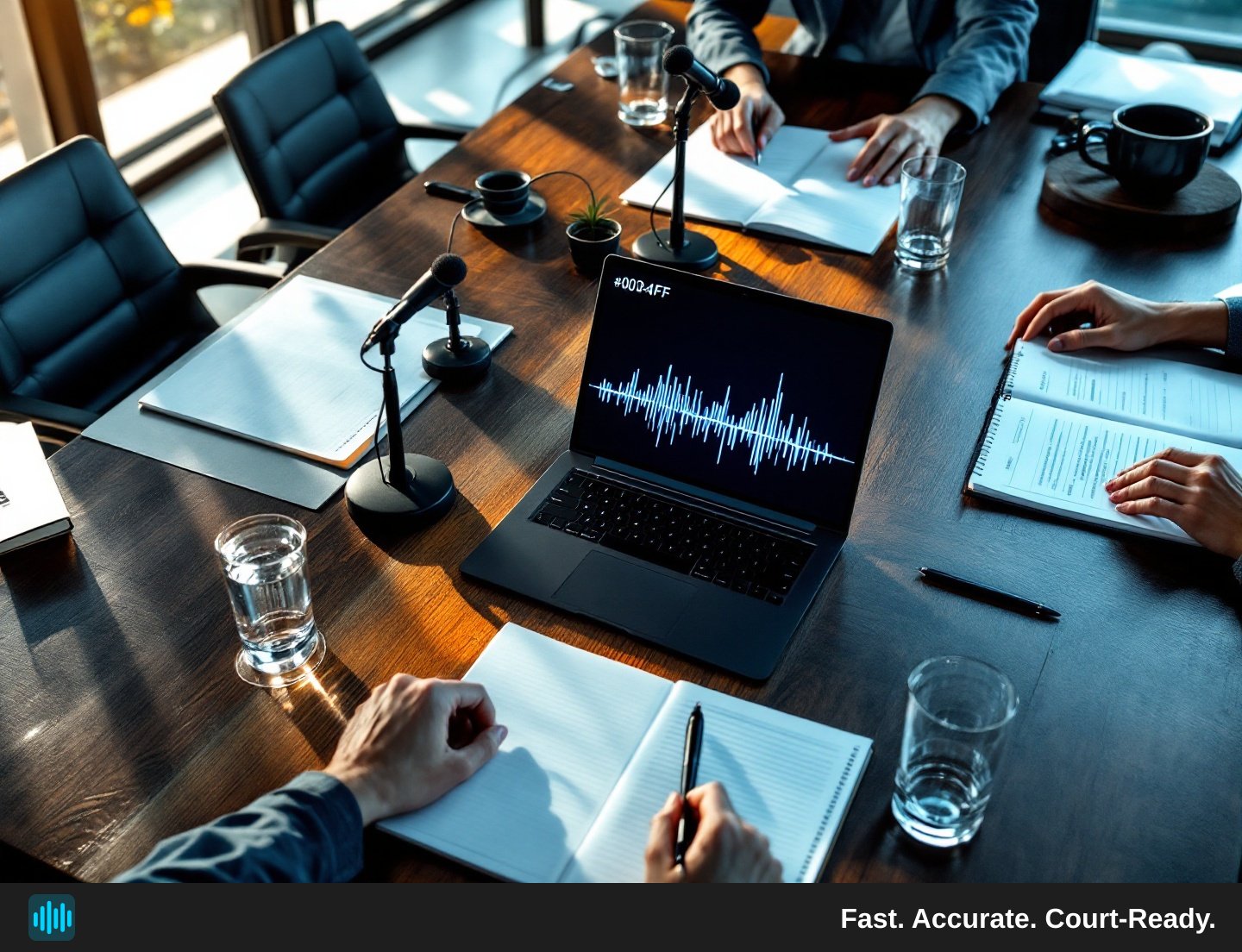
Anyone who has sat through a contentious deposition knows the chaos that can unfold on a recording: attorneys talking over each other, witnesses mumbling, court reporters asking for clarification, and the occasional background noise swallowing a critical answer. When that recording later needs to be transcribed, all of that acoustic complexity becomes a very real problem.
Multi-speaker legal recordings — depositions, recorded client interviews, hearings, bodycam footage, and wiretap audio — are among the most demanding transcription challenges in legal practice. Poor audio quality, overlapping speech, and unidentified speakers can turn a straightforward transcript into an unusable mess. Yet these recordings often contain the most consequential evidence in a case.
This guide walks through best practices attorneys can follow before, during, and after recording to maximize transcription accuracy, streamline speaker identification, and produce drafts that hold up to scrutiny.
Why Multi-Speaker Recordings Are Uniquely Difficult to Transcribe
Single-speaker recordings — a dictated memo, a voicemail — are relatively forgiving. Multi-speaker recordings are not. The challenges compound quickly:
Overlapping Speech and Cross-Talk
When two or more people speak simultaneously, even the most sophisticated transcription technology must make judgment calls about which voice to prioritize. In heated depositions, this can mean entire exchanges are rendered as unintelligible or attributed to the wrong speaker. The result is a transcript that may misrepresent who said what — a serious problem when the document will be used in motion practice or at trial.
Acoustic Similarities Between Speakers
Many speakers share similar pitch, accent, or cadence. In a room with three male attorneys and a male witness, the audio signal alone may not be enough to distinguish voices reliably. Speaker diarization — the process of segmenting audio by speaker — works best when voices are acoustically distinct. When they are not, human review becomes essential.
Unidentified Speakers and Anonymous Voices
Bodycam footage is a particularly striking example of this problem. A patrol officer's bodycam may capture a scene involving the officer, a suspect, bystanders, and other responding officers — none of whom are formally introduced on the recording. Without context, a transcription tool can label speakers only as "Speaker 1," "Speaker 2," and so on. That labeling is only as useful as the attorney's ability to later match those labels to real identities.
The same challenge arises in recorded phone calls, surveillance audio, and multi-party conference calls. Knowing that "Speaker 4 said X" is legally meaningless unless Speaker 4 can be identified.
Variable Audio Quality
Legal recordings are captured in wildly different environments. A formal deposition in a conference room with a professional recording setup is very different from a bodycam recording taken during a traffic stop in wind and traffic noise, or a phone call recorded on a consumer-grade app. Transcription accuracy tracks closely with audio quality — which means attorneys have a direct stake in how recordings are made.
Before the Recording: Setting Up for Transcription Success
The single highest-leverage moment for improving transcription quality is before the recording begins. Decisions made at the setup stage ripple forward through every downstream step.
Use Dedicated Microphones for Each Speaker When Possible
Conference-room microphones that capture everyone in the room are convenient but acoustically messy. Lapel microphones or individual desktop mics allow each speaker's voice to be captured on a cleaner, more isolated channel. Even in informal recorded interviews, a simple lapel mic clipped to the witness can dramatically improve the signal-to-noise ratio.
For depositions where a court reporter is present, coordinate with the reporter on microphone placement. Their goal and yours align: a clean recording benefits everyone.
Conduct a Formal Speaker Introduction at the Start
This is one of the simplest and most effective practices an attorney can adopt. At the beginning of every recorded proceeding, ask each participant to state their name clearly and their role in the proceeding. For example:
"For the record, please state your name and your role. We'll go around the table starting on my left."
This brief introduction accomplishes two things. First, it gives the transcription system — and any human reviewer — a reference sample of each speaker's voice tied to a known identity. Second, it creates a record that can be used to resolve any later dispute about who was present.
For bodycam footage and other recordings where this kind of introduction is not feasible, document the participants separately in your case notes so the voices can be matched to identities during review.
Minimize Background Noise Proactively
Close doors, silence phones, and ask support staff not to enter the room during recording. These steps feel obvious but are frequently overlooked in the rush of a busy litigation schedule. Background noise does not just make recordings harder to understand — it actively degrades speaker diarization by introducing acoustic signals that can confuse voice-separation algorithms.
During the Recording: Protocols That Protect the Transcript
Even with excellent setup, the behavior of participants during a recorded proceeding significantly affects transcription quality.
Enforce a "One Speaker at a Time" Rule
In depositions, it is standard practice — and often required by local rules — for only one person to speak at a time. In practice, this rule erodes quickly when attorneys object, witnesses talk over objections, or multiple counsel are present. As the taking attorney, you have both the right and the professional interest to enforce this norm.
When cross-talk occurs, pause the proceeding and ask that the last exchange be repeated clearly. This takes discipline in a heated deposition, but it pays dividends when you need a clean transcript for a summary judgment motion.
Use Names When Addressing Speakers
Instead of saying "Can you explain that further?" try "Mr. Johnson, can you explain that further?" Using names on the record creates natural speaker anchors in the audio. When a transcriptionist — human or AI — encounters a named address, it provides a contextual cue about who is speaking next.
This practice is especially valuable in multi-attorney depositions where several lawyers may ask questions in sequence. A simple "Counsel for defendant, your witness" or "Ms. Rivera, do you have any redirect?" costs nothing but provides significant clarity.
Note Significant Audio Events in Real Time
If a phone rings and creates interference, if a speaker steps away from the microphone, or if there is a prolonged pause, make a brief verbal note on the record: "Note for the record: the witness stepped away from the microphone for approximately thirty seconds." These annotations help anyone reviewing the transcript understand gaps or quality drops without assuming they represent missing content.
After the Recording: Getting the Most from AI Transcription
With a well-captured recording in hand, the transcription process itself becomes more tractable. AI transcription tools like TranscribeLegal are designed to handle the complexity of multi-speaker legal audio — but there are still practices that maximize output quality.
Use Speaker Diarization and Rename Labels Immediately
TranscribeLegal automatically identifies and labels up to 36 speakers in a single recording, assigning each a neutral label like "Speaker 1" or "Speaker 2." The critical next step is to rename those labels as soon as possible, while your memory of the proceeding is fresh.
Renaming "Speaker 3" to "Attorney Smith" and "Speaker 5" to "Witness Johnson" transforms a generic draft into a document that is immediately useful for legal work. It also reduces the risk that a speaker is misidentified during a rushed review later in the case cycle.
If you conducted a speaker introduction at the start of the recording (as recommended above), renaming is straightforward: listen to the first few minutes, match voices to names, and update the labels across the entire transcript.
Use Timestamped Search to Verify Critical Passages
Every statement in a TranscribeLegal transcript carries a clickable timestamp that jumps directly to that moment in the recording. For multi-speaker recordings, this feature is invaluable for verifying passages where speaker attribution is uncertain or where audio quality dipped.
Rather than listening to an entire two-hour deposition to find one disputed exchange, you can search the transcript for a keyword, locate the relevant passage, click the timestamp, and confirm the audio in seconds. This is particularly useful for bodycam footage, where the evidentiary value of specific moments often hinges on exactly who said what and when.
For attorneys evaluating a bodycam transcription tool, timestamped search is a significant efficiency feature — it allows targeted audio verification without scrubbing through an entire recording.
Build Human Review into Your Workflow
AI transcription produces high-quality drafts, but multi-speaker recordings with poor audio, heavy accents, or technical legal terminology will always benefit from human review before the transcript is relied upon in a filing or hearing. Build a review step into your workflow — either by a paralegal, legal secretary, or the attorney personally — to catch misattributions, fill in inaudibles, and verify speaker labels.
For sworn or certified work, human oversight is not optional. AI transcription is a powerful starting point, but the attorney's professional responsibility for accuracy does not transfer to the technology.
Managing Legal Transcription as a Litigation Expense
Transcription costs are a real line item in litigation, and attorneys should understand how to handle them appropriately. Transcription is a genuine per-matter litigation expense — similar in nature to court reporter fees or deposition costs — that a firm may bill to the client at cost, meaning the actual amount paid to the transcription service. Firms should consult their own counsel or ethics advisor regarding disclosure and consent obligations that apply in their jurisdiction.
When evaluating legal transcription pricing, it helps to think in terms of per-minute costs relative to the volume and frequency of your recordings. TranscribeLegal offers pay-as-you-go pricing at $0.25 per minute plus a $5 base fee per upload, as well as monthly plans starting at $49 per month for firms with consistent transcription volume. A free trial of 30 minutes — no credit card required — lets you evaluate quality before committing.
For firms handling high volumes of bodycam footage, recorded interviews, or multi-day depositions, a monthly plan typically offers better economics than per-upload billing. Comparing legal transcription pricing across service models is worth doing before the next major case lands.
TranscribeLegal also offers a downloadable Legal Transcription Pricing Guide that compares AI transcription costs against traditional court reporter rates — useful context for any firm evaluating its transcription workflow.
Data Security and Compliance for Multi-Speaker Legal Audio
Legal recordings are sensitive by definition. They may contain privileged communications, confidential client information, or protected health information. Before uploading any recording to a transcription service, attorneys should confirm that the platform meets their security obligations.
TranscribeLegal stores all data on US-based Microsoft Azure infrastructure, with AES-256 encryption at rest and TLS 1.3 in transit. The platform is HIPAA-compliant, with a Business Associate Agreement available and immutable audit logs retained for more than six years. All of this matters when the recordings being transcribed involve medical records, personal injury testimony, or other protected categories of information.
For multi-party recordings that may include protected health information — as is common in medical malpractice depositions or personal injury cases — confirming HIPAA compliance before uploading is a basic due diligence step.
Conclusion
Multi-speaker legal recordings will always be more demanding than single-speaker audio, but transcription quality is largely determined by decisions attorneys make before, during, and after the recording. The practices in this guide — speaker introductions, microphone discipline, real-time annotation, prompt speaker renaming, and structured human review — are low-cost habits with meaningful returns in accuracy and usability. One area that often goes unexamined until a major case arrives is transcription workflow economics: understanding what you are paying, how it compares to traditional alternatives, and whether a monthly plan or pay-as-you-go model fits your caseload. Getting that right before volume spikes is part of responsible case management. If you are ready to evaluate your options, See TranscribeLegal pricing to find the plan that fits your practice.