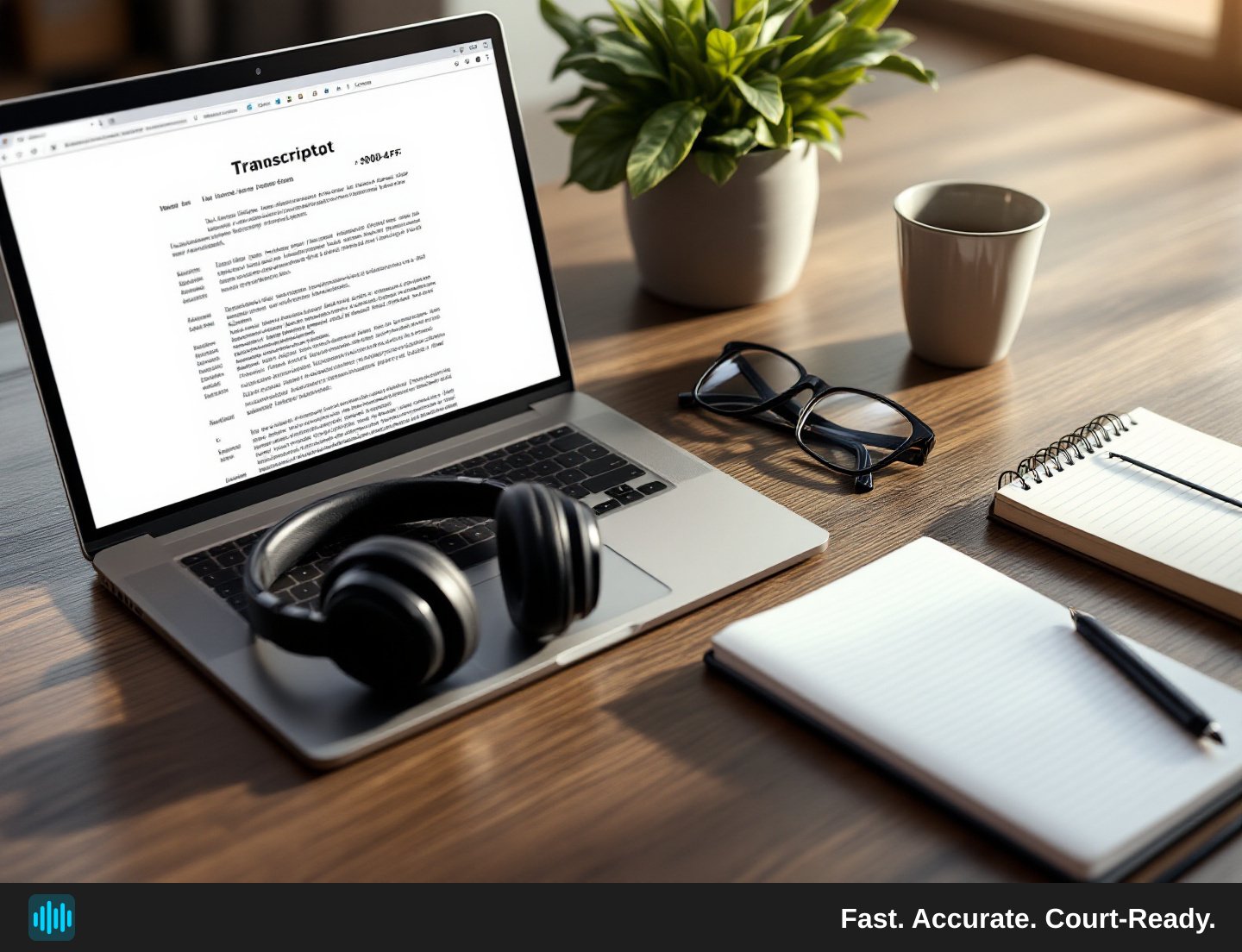
Transcribing depositions, hearings, client interviews, and other recorded proceedings is a routine — and often time-consuming — part of litigation practice. AI-assisted transcription has made first-pass drafts faster and more affordable, but many attorneys are still unsure how these tools fit into their workflow and billing practices.
This post walks through what AI transcription actually does, how firms are incorporating it as a per-matter expense, and what to keep in mind when passing that cost to clients.
What AI Transcription Produces
Tools like TranscribeLegal convert audio and video recordings into speaker-identified, timestamped first-pass drafts. The platform automatically labels up to 36 speakers and lets you rename them to real names or roles. Every statement gets a clickable timestamp so you can jump directly to that moment in the original recording.
Supported file types include common audio formats (MP3, WAV, M4A, AAC, FLAC, OGG, WMA) and video formats (MP4, MOV, AVI, MKV, WMV, WebM). For courtroom recordings, TranscribeLegal reads FTR (.trm) multi-channel files and transcribes each microphone channel separately — though it cannot distinguish multiple people sharing a single microphone channel.
The platform supports 90+ languages with automatic language detection, making it useful for matters involving non-English speakers.
What AI Transcription Does Not Do
It is important to be precise about what these tools produce. TranscribeLegal generates a first-pass draft — not a certified transcript. Certification and signing are performed by the licensed human professional reviewing and attesting to the final document. The platform does not replace a court reporter, does not provide sworn records, and does not offer real-time transcription during live proceedings.
It also does not offer human proofreading or translation services. The transcript export options — Q&A RTF for Word, plain text/ASCII, SRT/VTT subtitles, and certified PDF — are designed to support the attorney's or court reporter's own review and certification workflow.
Billing AI Transcription as a Litigation Expense
Per-matter transcription costs are generally treated as a litigation disbursement, similar to filing fees or copying costs. When a firm uses TranscribeLegal, it pays a straightforward per-minute rate ($0.25/min pay-as-you-go, or a monthly plan ranging from $49 to $249/month). That cost may be passed to the client at cost — meaning exactly what the firm paid — with appropriate disclosure and client consent.
Firms should not mark up AI transcription costs to court reporter rates or treat the service as a revenue line. Consult your jurisdiction's ethics rules and your engagement letter practices for guidance on disbursement billing and disclosure obligations. No specific bar rule is cited here because requirements vary by jurisdiction.
Illustrative example (hypothetical): A firm handling a multi-day commercial dispute uploads 10 hours of deposition recordings. At $0.25/min, the transcription cost is $150 — disclosed to the client as a disbursement and billed at cost. The attorney reviews the AI draft, makes corrections, and the final transcript is produced under the attorney's supervision.
Practical Workflow Considerations
- Start with the free tier: TranscribeLegal offers the first 30 minutes free with no credit card required, which is enough to evaluate accuracy on your typical recording quality before committing to a plan.
- Use full-text search: The platform's full-text search with highlighted results lets you locate testimony on a specific topic across a long transcript without reading every page.
- Export for your workflow: Q&A RTF exports are formatted for Word, making it straightforward to edit and finalize the document in the tools your firm already uses.
- Certified PDF for chain of custody: The certified PDF export includes a certification statement, signature field, and chain-of-custody information — useful when the transcript needs to accompany a filing or be shared with opposing counsel.
HIPAA Compliance for Legal-Adjacent Healthcare Matters
For firms handling healthcare litigation, workers' compensation matters, or personal injury cases involving medical records and recorded interviews, TranscribeLegal is HIPAA compliant with encrypted transit and storage. A Business Associate Agreement (BAA) is available and is included on the Advanced plan.
Court Reporters and Transcription Agencies
TranscribeLegal also offers monthly plans with 30% more included minutes for court reporters, transcribers, and agencies — recognizing that these professionals often process high volumes of recordings and benefit from a volume-friendly pricing structure.
Getting Started
If your firm regularly transcribes depositions, client interviews, or hearing recordings, AI-assisted transcription is worth evaluating as a way to reduce turnaround time and per-matter cost. The first 30 minutes are free at transcribelegal.ai — no credit card required.
As with any tool that touches client matters, review your engagement letter, disclosure practices, and applicable ethics guidance before incorporating it into your billing workflow.