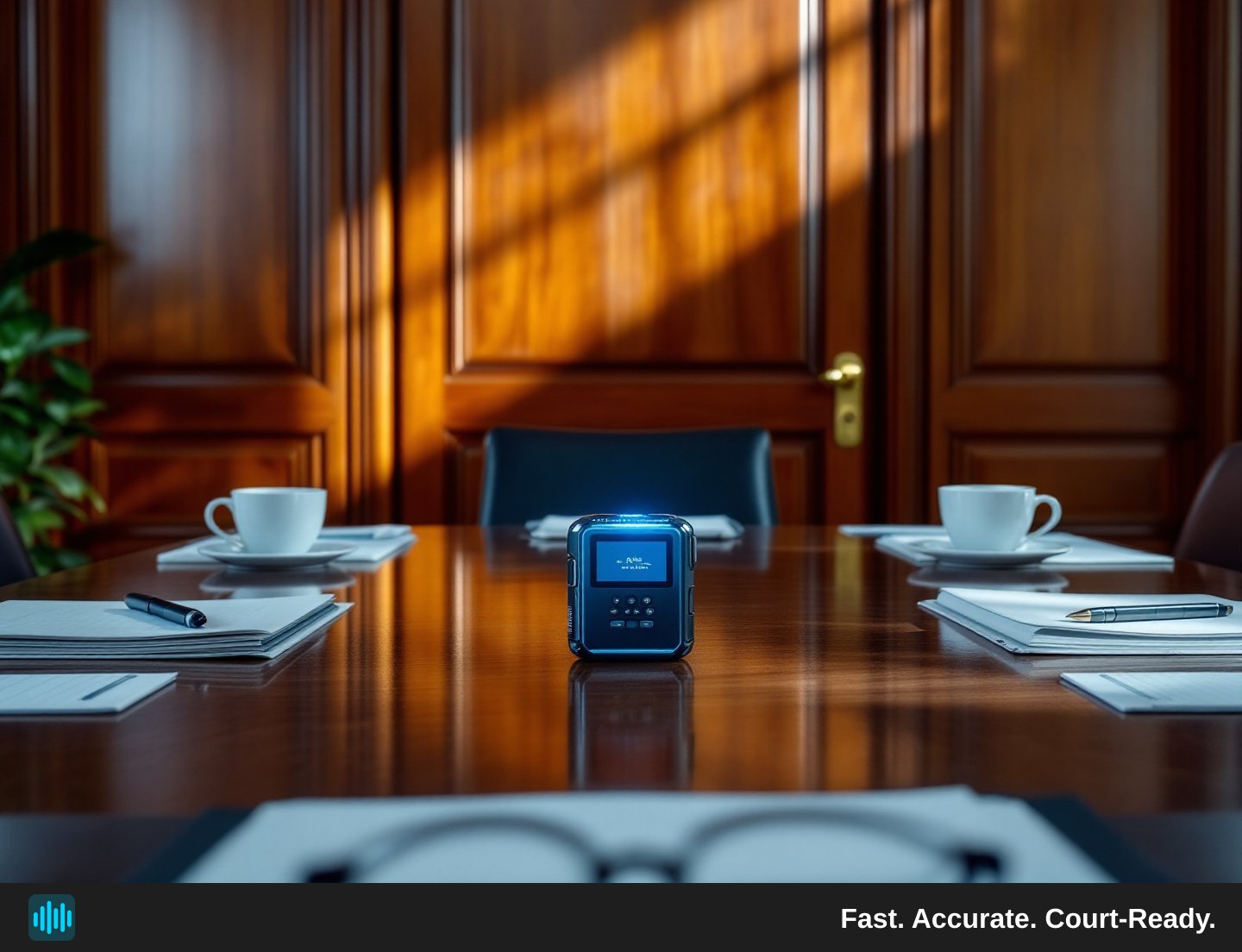
Grand jury proceedings occupy a uniquely sensitive corner of the American legal system. They are secret by design — witnesses testify without opposing counsel present, jurors deliberate without public scrutiny, and the record itself is shielded from disclosure under rules that vary by jurisdiction but share a common thread: what happens in the grand jury room stays there, unless a court orders otherwise.
Yet that same record must be accurate. Grand jury transcripts are used to impeach witnesses at trial and to support or challenge indictments. In some jurisdictions and circumstances, they may also become relevant on appeal — for example, when a defendant argues that the indictment was improperly obtained — though their role in appellate proceedings is jurisdiction- and circumstance-dependent rather than universal. A single misheard word — a "not" dropped from a denial, a name rendered phonetically wrong — can have consequences that ripple through years of litigation.
For litigation attorneys, court reporters, and legal professionals who handle grand jury recordings or transcripts, the challenge is managing both obligations simultaneously: preserving confidentiality at every step of the transcription process while producing a first-pass draft accurate enough to support the human review that certification requires.
Why Grand Jury Confidentiality Shapes Every Transcription Decision
The secrecy of grand jury proceedings is not a formality. It serves multiple recognized purposes: protecting witnesses from retaliation before an indictment is returned, preventing targets from fleeing or destroying evidence, encouraging candid testimony, and preserving the integrity of deliberations. Courts have long treated grand jury materials as presumptively protected, and disclosure — even inadvertent — can trigger serious professional and legal consequences.
This confidentiality obligation does not end when the proceeding closes and the recording is handed to a transcriptionist. It follows the audio file, the draft transcript, and every copy made along the way. For legal teams evaluating how traditional law transcriptionist services compare to AI transcription services in this context, data handling is often the first question on the table — and rightly so.
When a recording is sent to a human transcription service, the chain of custody includes every employee who touches the file, every platform used to transmit it, and every storage location where it rests. Traditional services may offer confidentiality agreements, but the number of human touchpoints may differ from AI-assisted alternatives — a distinction worth weighing as one factor when evaluating confidentiality exposure, though attorneys should assess any platform's underlying cloud infrastructure and data-handling practices independently, and should not treat reduced human touchpoints as a guaranteed confidentiality outcome.
TranscribeLegal is HIPAA compliant, with encrypted transit and encrypted storage, and offers a Business Associate Agreement on its Advanced plan. While grand jury proceedings are not HIPAA-covered by definition, the same encryption architecture that satisfies HIPAA's technical safeguards is directly relevant to the confidentiality demands of sensitive legal proceedings. Attorneys should evaluate any transcription platform against their jurisdiction's specific grand jury secrecy rules and their own firm's data governance policies.
Accuracy Standards in Grand Jury Transcripts: What's Actually at Stake
Grand jury transcripts become litigation documents. They are used at trial to cross-examine witnesses whose testimony has shifted and attached to motions challenging the sufficiency of evidence presented to the grand jury. The accuracy bar is therefore the same as it is for any court-ready transcript — and in some respects higher, because the proceeding cannot be re-run.
Deposition-style court transcript punctuation guidelines apply to grand jury transcripts just as they do to any verbatim record. Speakers must be clearly identified and consistently labeled throughout. Interruptions, overlapping speech, and incomplete sentences must be marked according to established conventions — typically with em dashes for interruptions and ellipses for trailing off. Inaudible or unclear passages must be flagged with a notation rather than guessed at, because a wrong guess is worse than an acknowledged gap.
To illustrate the stakes with a hypothetical scenario: imagine a prosecutor reviewing a grand jury transcript draft discovers that a witness's answer to a key question has been transcribed as "I never spoke to him" when the audio, on close review, reveals "I never spoke to him about that." The omitted phrase changes the witness's exposure dramatically. If that error survived into a certified transcript and was later used at trial, the consequences — for the case and potentially for the professional who certified the transcript — could be significant. This is a hypothetical example, but it reflects the kind of consequential error that thorough human review is designed to catch.
This is precisely why AI-generated first-pass drafts are tools for human review, not replacements for it. TranscribeLegal produces speaker-identified, timestamped draft transcripts. The clickable timestamps linked to the audio allow a reviewing attorney or court reporter to jump directly to any passage in question and verify the language against the recording. That verification step is where accuracy is confirmed — and where the human professional's judgment is irreplaceable.
How AI-Assisted Transcription Fits Into the Grand Jury Workflow
Understanding how traditional law transcriptionist services compare to AI transcription services in a grand jury context requires looking at the actual workflow, not just the output.
In a traditional workflow, a court reporter is present during the grand jury proceeding and produces a stenographic record in real time. That record is then transcribed into a readable format, reviewed, and certified. When a recording already exists — because the proceeding was recorded digitally rather than stenographically, or because a recording supplement is needed — a human transcriptionist listens to the audio and produces a draft, which is then reviewed and certified.
AI-assisted transcription enters the workflow at the draft-production stage. Instead of a human transcriptionist spending hours listening and typing, the audio is processed automatically, producing a speaker-labeled, timestamped draft in a fraction of the time. That draft is then reviewed by a qualified professional — a court reporter, a legal secretary, or the supervising attorney — who corrects errors, verifies speaker attributions, and ensures that the final document meets applicable formatting standards before certification.
For grand jury recordings specifically, this workflow offers two practical advantages. First, speed: grand jury transcripts are sometimes needed quickly, particularly when a defendant has been indicted and defense counsel is seeking early access to the record. A fast first-pass draft compresses the overall timeline without sacrificing the review step. Second, processing audio automatically rather than routing it through a human transcriptionist may reduce the number of people who handle the file during the draft-production phase — a factor worth considering as part of a broader confidentiality assessment, though it does not eliminate the need for careful platform vetting.
Grand jury proceedings are frequently captured via multi-channel recording systems, and TranscribeLegal supports FTR (.trm) multi-channel courtroom recordings, splitting audio by microphone channel. This is particularly relevant for grand jury work, where the foreperson, prosecuting attorney, and witnesses may each be recorded on separate channels — allowing the platform to produce a more accurately speaker-separated draft than a single mixed-channel recording would permit. Note that TranscribeLegal cannot distinguish individual people who share a single microphone channel; channel-level separation is the mechanism for speaker differentiation in multi-channel files.
TranscribeLegal also supports audio formats including MP3, WAV, M4A, AAC, FLAC, OGG, and WMA, and video formats including MP4, MOV, AVI, MKV, WMV, and WebM. It identifies and labels up to 36 speakers automatically, with the ability to rename speakers to their actual names or roles — essential for a grand jury transcript where the foreperson, prosecutor, and individual witnesses each need consistent, identifiable labels throughout the document.
Formatting Grand Jury Transcripts to Court-Ready Standards
Court transcript punctuation guidelines and deposition-style formatting conventions are not optional in grand jury transcripts intended for litigation use. They are the difference between a document that functions as a legal record and one that creates confusion during cross-examination or appellate review.
Several formatting principles apply consistently across jurisdictions and proceeding types:
Speaker identification: Each speaker's name or role appears on a new line before their statement. In a grand jury context, this typically means identifying the foreperson, the prosecuting attorney, and each witness by name. Juror questions, when they occur, should be attributed to the specific juror if identifiable or to "JUROR" if not.
Verbatim accuracy: Grand jury transcripts are verbatim records. False starts, filler words, and grammatical errors in speech are preserved as spoken. The transcript reflects what was said, not what the speaker meant to say.
Inaudible and unclear notations: Passages that cannot be heard clearly are marked with a bracketed notation — typically "[INAUDIBLE]" or "[INDISCERNIBLE]" — rather than filled in with a best guess. Uncertain words may be followed by "[sic]" or placed in brackets with a question mark to signal uncertainty.
Interruptions and overlapping speech: Em dashes mark abrupt interruptions. When two speakers overlap briefly, the convention varies by jurisdiction but typically involves a notation in brackets.
Exhibit references: When documents or physical evidence are presented to the grand jury, the transcript should note the exhibit number and a brief description at the point of reference.
TranscribeLegal exports transcripts in Q&A RTF format (compatible with Microsoft Word), plain text, SRT, VTT, and certified PDF. The Q&A RTF format is a structured export format that can serve as a useful starting point for grand jury testimony drafts — though the reviewing professional should verify that the final document meets any jurisdiction-specific formatting requirements before certification. The certified PDF export allows a court reporter or qualified transcriptionist to attach their signature and certification — because certification is always the act of the human professional, not the platform.
Practical Steps for Protecting Confidentiality During Transcription
For attorneys and court reporters handling grand jury recordings, a few practical steps can significantly reduce confidentiality risk during the transcription process:
Limit file distribution: Send the recording only to the platform or individual who will produce the draft. Avoid forwarding audio files through unsecured email or storing them on personal devices.
Use encrypted transmission: Ensure that any platform used to upload or process the recording uses encrypted transit. TranscribeLegal encrypts both transit and storage.
Maintain a chain-of-custody log: Document who has accessed the recording and the draft transcript at each stage. This is standard practice for sensitive litigation materials and applies equally to grand jury records.
Review access controls: Confirm that only the individuals who need to review the transcript have access to the file, and review the platform's account and access settings accordingly before uploading sensitive recordings.
Understand your jurisdiction's rules: Grand jury secrecy rules vary. Some jurisdictions permit the prosecuting attorney to share transcripts with the defense after indictment; others impose ongoing restrictions. Know the rules that apply before distributing any draft or final transcript.
Certify only after thorough review: The certified transcript is the official record. No AI-generated draft should be certified without a complete review against the audio. Use the clickable timestamps in TranscribeLegal's interface to verify every flagged or uncertain passage before the certifying professional signs off.
Choosing the Right Transcription Approach for Grand Jury Work
For legal professionals weighing how traditional law transcriptionist services compare to AI transcription services in the grand jury context, the answer is not binary. The most effective approach combines the speed and potential reduced-touchpoint advantages of AI-assisted draft production with the irreplaceable judgment of a qualified human reviewer.
AI transcription is not a shortcut around the review process — it is an acceleration of the draft-production phase that leaves more time and cognitive bandwidth for the review phase, where accuracy is actually confirmed. For proceedings as consequential as grand jury testimony, that distinction matters.
TranscribeLegal's pricing starts at $0.25 per minute on a pay-as-you-go basis, with monthly plans from $49 to $249 per month and the first 30 minutes free with no credit card required. Transcription costs are a per-matter litigation expense that a firm may pass through to the client at cost — meaning at what the firm actually pays TranscribeLegal — with appropriate disclosure and client consent. For a full breakdown of what each plan includes, See TranscribeLegal pricing.