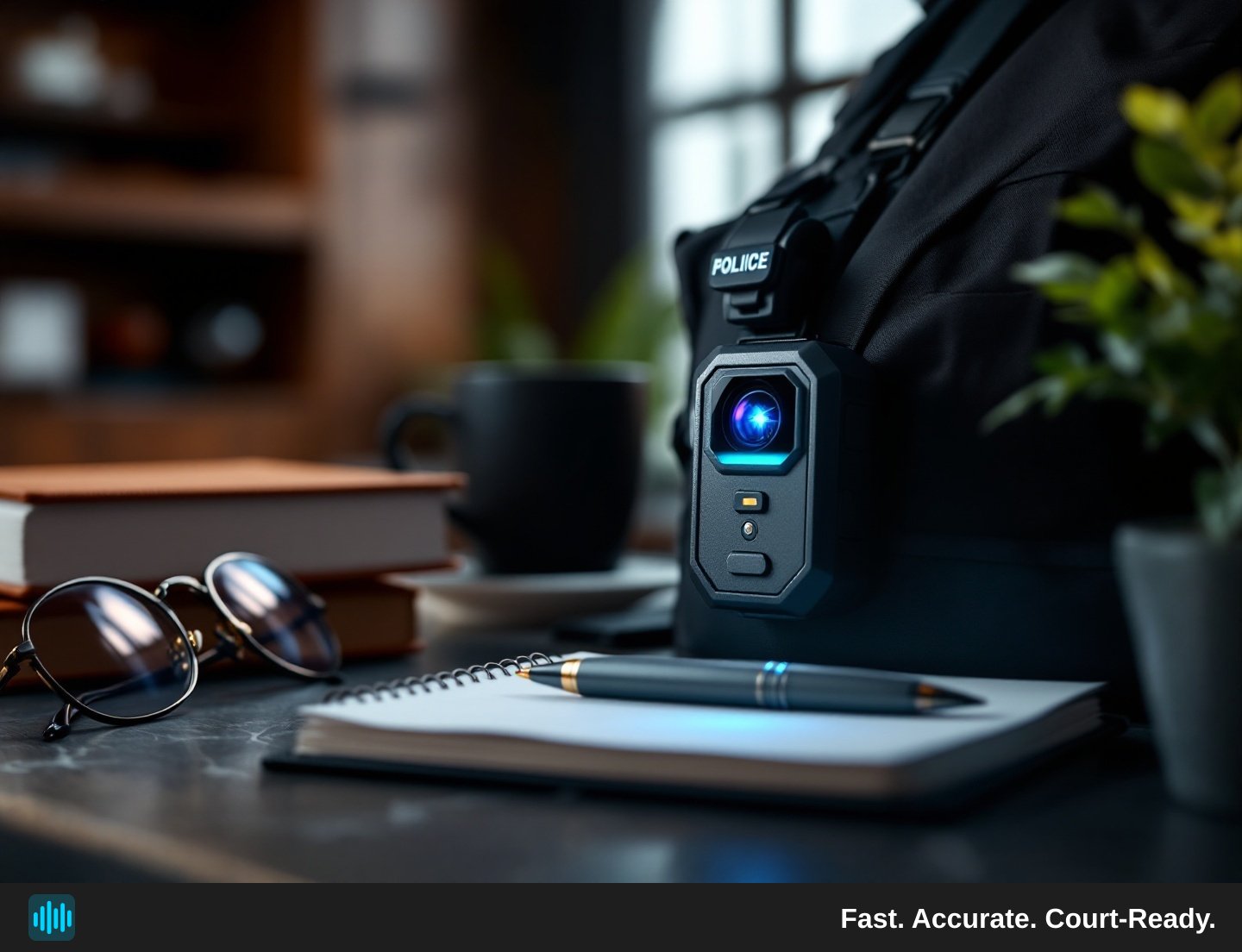
Law enforcement body camera footage has become one of the most consequential forms of evidence in modern litigation. From criminal trials to civil rights claims, the audio captured on a patrol officer's chest can make or break a case. Yet the footage itself — often recorded in chaotic, acoustically challenging environments — is only as useful as the team's ability to accurately document what was said, by whom, and when.
Transcribing body cam footage is not simply a convenience. For litigation attorneys, it is a foundational step in evidence preparation. A precise, timestamped, speaker-labeled transcript allows counsel to cross-reference testimony, locate specific statements in seconds during depositions, and present a court-ready record that supports — rather than undermines — the admissibility of the underlying recording.
This post walks through the unique challenges of body cam audio, how courts evaluate transcription accuracy, what a reliable bodycam transcription tool should deliver, and how legal teams can build a defensible workflow around this increasingly central category of evidence.
Why Body Cam Audio Is Uniquely Difficult to Transcribe
Body camera recordings are not studio-quality audio. They are captured in the field, often at night, during physically demanding encounters, in environments full of competing noise. Understanding these challenges is the first step toward addressing them.
Acoustic Conditions That Complicate Transcription
Background noise is the most obvious obstacle. Traffic, wind, crowds, radio chatter, and the physical movement of the officer all degrade audio clarity. Speakers may be at varying distances from the microphone. Voices overlap during high-stress encounters. Accents, dialects, and speech patterns vary widely among speakers.
Beyond noise, the microphone placement on body cameras creates a directional problem: the officer's own voice is captured most clearly, while the voices of civilians, witnesses, or other officers can be significantly quieter or muffled. In a transcript intended for court use, this asymmetry matters enormously. Misattributing a statement — or missing one entirely — can alter the factual record in ways that affect both admissibility arguments and substantive outcomes.
Multiple Speakers, Shifting Roles
A single body cam clip may capture the arresting officer, a backup officer, a suspect, a witness, a dispatcher on radio, and bystanders — all within a few minutes. Without speaker diarization (the automated identification and labeling of distinct voices), a raw transcript is a confusing wall of text with no attribution. Courts and opposing counsel will question its reliability immediately.
A capable bodycam transcription tool must not only separate speakers but allow legal teams to rename generic labels — "Speaker 1," "Speaker 2" — to meaningful identifiers such as "Officer Reyes" or "Defendant Williams." That renaming step transforms a rough AI draft into a document that can be used in deposition preparation, motion practice, and trial.
How Courts Evaluate Transcription Accuracy
Admissibility of a transcript is a distinct question from admissibility of the underlying recording. In most jurisdictions, the recording itself is the primary evidence. A transcript is typically offered as an aid — something the jury or judge can follow along with while listening. But that distinction does not make accuracy optional. It makes it more important.
The "Aid to the Jury" Standard
When transcripts are offered as demonstrative aids, courts in many jurisdictions have procedures for evaluating their accuracy — though specific requirements, including what foundation must be laid and how accuracy is established, vary significantly by court and jurisdiction. Consult local rules and applicable case law for the requirements in your forum. If opposing counsel can point to specific errors — a misheard word, a misattributed statement, a missing exchange — the transcript may be excluded or, worse, may undermine the credibility of the party offering it.
This is why the review step is non-negotiable. AI transcription produces a draft. A trained legal professional — paralegal, legal secretary, or attorney — must listen to the recording against the transcript and correct errors before the document is used in any proceeding. No AI tool, regardless of accuracy claims, eliminates that human review obligation for sworn or court-filed work. For work requiring certified or court-reporter-signed transcripts, human certification remains necessary; AI-generated drafts alone do not satisfy that requirement.
Timestamping as a Verification Mechanism
One of the most practical features a legal team should demand from any transcription tool is clickable, precise timestamps on every statement. When opposing counsel challenges a line of the transcript, the attorney needs to be able to navigate directly to that moment in the recording — not scrub through an hour of footage manually. Timestamps also allow attorneys to correlate transcript statements with other evidence: surveillance footage, 911 call logs, or CAD records that carry their own time references.
Timestamped transcripts are not just a convenience feature. In contested admissibility hearings, they are the mechanism by which counsel demonstrates that the transcript faithfully represents the recording.
Building a Defensible Transcription Workflow
For litigation teams that regularly handle body cam evidence, an ad hoc approach — sending files to different vendors or relying on informal transcription — creates inconsistency and risk. A repeatable, documented workflow is both a quality control measure and a professional responsibility practice.
Step 1: Intake and File Preparation
Body cam footage typically arrives as MP4, MOV, or AVI files — common video formats. Before uploading to a transcription platform, confirm the file is complete and unaltered. Document the chain of custody for the original file. If the footage has been clipped or edited by the producing agency, note that in your file. TranscribeLegal accepts video files including MP4, MOV, AVI, MKV, WMV, and WebM, up to 2 GB and 4 hours per file, which covers the vast majority of individual body cam clips.
Step 2: Upload, Transcribe, and Label Speakers
Once uploaded, TranscribeLegal's AI identifies and labels up to 36 distinct speakers — more than sufficient for even complex multi-officer encounters. The platform supports automatic language detection across 80+ languages, so if an encounter is recorded in a language other than English, the tool will transcribe in that source language. Note that transcription is in the source language only; the tool does not translate recordings into another language. If a translation is needed, that is a separate step requiring a qualified human translator.
After the AI draft is generated, the legal team should rename speaker labels to real identifiers. This is a short but critical step that turns a generic AI output into a usable legal document.
Step 3: Human Review Against the Recording
Play back the recording while reading the transcript. Flag every discrepancy. Pay particular attention to: words spoken under stress or at low volume; overlapping speech; radio transmissions; and any statement that could be interpreted as legally significant — an invocation of rights, a consent or refusal, a threat, an admission. Correct the transcript in the platform or in a Word export.
TranscribeLegal exports to PDF, Word (DOCX), plain text, and SRT subtitles. For court filings and deposition exhibits, DOCX provides the most flexibility for formatting adjustments; PDF is appropriate for final filing.
Step 4: Document the Process
Maintain a record of who reviewed the transcript, when, and what corrections were made. This documentation supports the foundation testimony that may be required if the transcript is offered as a court aid. It also protects the firm in the event of a later challenge.
Security, Compliance, and Client Confidentiality
Body cam footage frequently contains sensitive personal information: names, addresses, medical details, and the identities of minors or victims. Legal teams have professional obligations around how they handle this material, and those obligations extend to the vendors and platforms they use.
Encryption and Data Residency
TranscribeLegal stores all data on US-based Microsoft Azure infrastructure with AES-256 encryption at rest and TLS 1.3 in transit. For legal teams handling criminal defense, civil rights litigation, or any matter involving protected personal information, knowing that data does not leave US-based servers is a baseline requirement.
HIPAA Compliance for Overlapping Matters
In cases where body cam footage captures medical encounters — an officer responding to a mental health crisis, for example — the recording may contain protected health information. TranscribeLegal is HIPAA-compliant, with end-to-end encryption, a Business Associate Agreement (BAA) available, and immutable audit logs retained for six or more years. Those audit logs also serve as a chain-of-custody record for the transcription process itself.
Legal Transcription Pricing: Understanding the Cost as a Litigation Expense
For firms that handle body cam evidence routinely, understanding legal transcription pricing is part of responsible matter budgeting. TranscribeLegal offers pay-as-you-go pricing at $0.25 per minute plus a $5 base fee, and monthly plans starting at $49 per month. There is also a free trial of 30 minutes with no credit card required — a practical way to test accuracy on a sample clip before committing to a workflow.
Transcription is a genuine per-matter litigation expense, similar in character to court reporter fees or deposition costs. A firm may pass the cost — what the firm actually pays TranscribeLegal — through to the client at cost, without markup. It should not be marked up to court reporter rates or treated as a revenue line. Firms should consult their own ethics counsel regarding billing practices and disclosure requirements in their jurisdiction.
For firms evaluating options, TranscribeLegal also offers a downloadable Legal Transcription Pricing Guide 2026 that compares AI transcription against traditional court reporter costs — a useful reference when advising clients on matter budgets.
Conclusion: Accuracy Is the Foundation
Body cam footage is powerful evidence, but only when it is handled with the same rigor applied to any other exhibit. A sloppy transcript — one with misattributed statements, missing exchanges, or no timestamps — does not just fail to help. It actively creates risk: for admissibility, for credibility, and for the client's case. The investment in a reliable, secure, and well-documented transcription workflow pays for itself the first time opposing counsel challenges a line of the record and you can navigate directly to the timestamp that proves them wrong.
For litigation teams ready to build that workflow, See TranscribeLegal pricing to find the plan that fits your caseload.