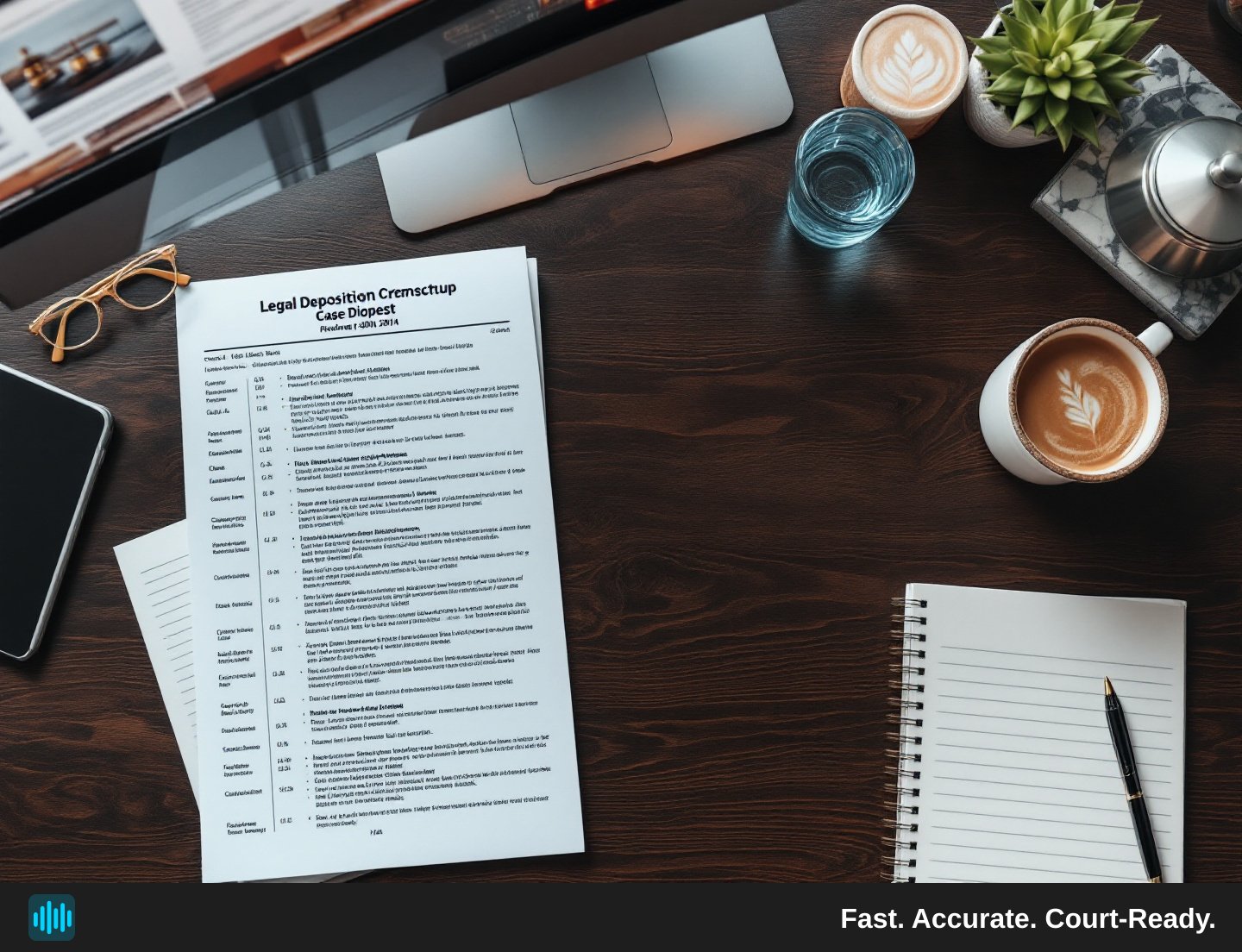
A deposition transcript is one of the most information-dense documents in litigation. A single day of testimony can run hundreds of pages, covering everything from background biography to granular technical detail. For the attorney preparing for trial, arbitration, or a dispositive motion, the transcript is not the destination — the digest is. A well-built digest is organized by theme, keyed to the record, and ready to support a brief or cross-examination outline.
AI tools have changed how quickly that transformation can happen. But understanding what AI actually does well — and where careful human review remains non-negotiable — is what separates a litigator who uses these tools effectively from one who gets burned by an unreviewed draft. This post walks through the full workflow: from getting a clean, properly formatted transcript out of a deposition recording to building a case digest that holds up under scrutiny.
Why the Transcript Quality Determines the Digest Quality
Before any summarization can happen, you need a transcript that is accurate, speaker-identified, and formatted to deposition style guide standards. Garbage in, garbage out is never more true than in legal AI workflows. An AI summarization tool reading a poorly formatted transcript — one where speaker turns are mislabeled, where overlapping speech has collapsed into a single block, or where technical terminology has been mangled — will produce a digest that reflects every one of those errors, often without any visible signal that something went wrong.
Getting the Foundation Right: Formatting and Speaker Diarization
Deposition-style formatting has specific conventions that matter downstream. Question-and-answer format, accurate speaker labels, consistent punctuation, and clean paragraph breaks are not cosmetic preferences — they are structural signals that both human readers and AI tools use to parse meaning. When an examiner's question runs into the witness's answer because speaker turns were not properly separated, an AI summarization pass may attribute the wrong statement to the wrong speaker. That kind of error in a case digest can mislead strategy.
TranscribeLegal produces speaker-identified, timestamped first-pass drafts from deposition audio and video recordings. It automatically detects and labels up to 36 speakers, and users can rename those labels to reflect actual participant names — attorney, witness, interpreter, and so on. The Q&A RTF export format mirrors the question-and-answer structure that deposition style guides call for, making it a natural starting point for the summarization workflow that follows. Clickable timestamps let a reviewer jump directly from any line in the transcript to the corresponding moment in the audio — an essential check when something in the draft looks off.
The platform reads FTR (.trm) multi-channel courtroom recording files directly, which is particularly useful for depositions conducted in venues that use For The Record recording systems. It also supports the full range of common audio and video formats — MP3, WAV, M4A, MP4, MOV, and more — so the recording format is rarely a barrier.
Punctuation and Transcript Style: Why Small Details Matter for AI Summarization
Court transcript punctuation guidelines exist for a reason. A comma splice in ordinary prose is a style choice; in a deposition transcript, it can obscure whether a witness was making one statement or two. AI summarization tools parse sentence boundaries, clause structures, and attribution markers. When punctuation is inconsistent — em-dashes used interchangeably with ellipses, incomplete sentences left without terminal punctuation, parentheticals not properly closed — the downstream summary inherits that ambiguity.
When reviewing a first-pass transcript before running it through any summarization tool, pay attention to:
- Question marks on all examiner questions. An interrogative sentence without a question mark can be misread as a declarative statement.
- Consistent speaker label formatting. Labels like "Q:" and "A:" or "MR. SMITH:" and "THE WITNESS:" should be uniform throughout. Mixed conventions confuse parsing.
- Ellipses vs. dashes for interrupted speech. Deposition style guides typically use an em-dash to indicate an interruption and an ellipsis to indicate a trailing off. Mixing them creates ambiguity about whether testimony was cut off or simply incomplete.
- Exhibit references. When a witness says "this document" and the transcript does not reflect that an exhibit was marked, the reference becomes a floating pronoun that summarization tools cannot resolve.
These are the kinds of corrections a human reviewer makes during the transcript review stage — before the digest workflow begins.
Building the Case Digest: Structure and Strategy
Once you have a clean, properly formatted transcript, the digest workflow can begin. A case digest is not a summary in the general sense — it is a structured analytical document organized to serve specific litigation purposes. The structure you choose should reflect how the digest will actually be used.
Common Digest Architectures
Chronological narrative. Useful when the deposition covers a sequence of events and you need to reconstruct a timeline. The digest condenses testimony into a narrative that follows the underlying facts, not the order in which questions were asked.
Thematic organization. Useful for complex depositions covering multiple disputed issues. Each section of the digest addresses a discrete legal or factual issue — liability, damages, notice, causation — and collects all relevant testimony under that heading regardless of where it appeared in the transcript.
Impeachment and credibility index. A specialized digest focused on inconsistencies: places where the witness's deposition testimony diverges from prior statements, other deponents' accounts, documentary evidence, or the witness's own earlier answers within the same deposition. This format is built for cross-examination preparation.
Key admission log. A compact digest that extracts only the most significant admissions, concessions, and statements against interest, with page-and-line citations for each. Useful for motion practice and trial preparation.
Most litigators use a combination of these formats depending on the witness and the stage of the case.
Where AI Summarization Helps — and Where It Does Not
AI summarization tools can accelerate the first pass of a digest dramatically. They are effective at:
- Condensing long narrative answers into shorter paraphrases
- Identifying recurring themes across a lengthy transcript
- Generating a rough chronological sequence from testimony
Note that detecting contradictions across multiple deponent transcripts or documents is a capability of specialized litigation analysis platforms — it is not something AI summarization tools or TranscribeLegal perform automatically. Within a single transcript, a human reviewer remains the most reliable check for inconsistencies and credibility issues.
To illustrate the workflow: hypothetically, a firm handling a multi-witness products liability case might use an AI summarization tool to produce a first-pass digest of a three-hour engineering expert deposition, then have a junior associate review and refine it. The AI pass reduces the initial review time; the associate's review catches the nuances the AI missed — the hedged qualifier buried in a long answer, the moment the witness pivoted from a prior position, the exhibit reference that the AI treated as a general statement.
AI tools are less reliable at:
- Evaluating the legal significance of testimony (that requires knowing the elements of the claim)
- Detecting subtle hedging or evasion in witness answers
- Correctly handling highly technical subject matter where terminology is domain-specific
- Resolving ambiguous pronoun references without context from outside the transcript
- Producing citations in the precise page-and-line format required for motion practice without human verification
The digest that goes into a brief or gets handed to trial counsel must be human-reviewed. AI produces a draft; the attorney or paralegal produces the final work product.
Integrating the Transcript-to-Digest Workflow Into Litigation Practice
The practical question is not whether AI summarization is useful — it clearly is — but how to integrate it into an existing litigation workflow without creating new quality-control risks.
A Practical Workflow for Deposition Digest Production
Step 1: Produce the first-pass transcript. Upload the deposition recording to TranscribeLegal. The platform generates a speaker-identified, timestamped draft. For depositions with multiple participants, rename the speaker labels immediately — before sharing the transcript with anyone else on the team.
Step 2: Review and correct the transcript. A paralegal or associate reviews the draft against the audio using the clickable timestamp navigation. Corrections focus on speaker attribution errors, technical terminology, exhibit references, and punctuation consistency in line with deposition style guide conventions. This step is not optional — it is what makes the downstream digest reliable.
Step 3: Export in the appropriate format. For digest production, the Q&A RTF export provides a clean, structured document. For teams that want to search across multiple transcripts, TranscribeLegal's full-text search with timestamp linking allows cross-transcript research before the digest is even drafted.
Step 4: Run the summarization pass. Feed the corrected transcript into your AI summarization tool of choice. Define the digest structure you need — thematic, chronological, impeachment-focused — and generate the first-pass digest.
Step 5: Human review and refinement. The attorney or senior paralegal reviews the digest against the transcript, verifying citations, correcting misattributions, adding legal significance notes, and flagging items for follow-up. The final digest is the attorney's work product, not the AI's output.
Step 6: Distribute and version-control. Digests should be version-controlled and dated. As the case develops and additional depositions are taken, the digest may need to be updated to reflect new testimony.
Managing Cost and Billing
Transcription of deposition recordings is a genuine per-matter litigation expense. A firm may bill the cost of transcription to the client at cost (what the firm actually pays TranscribeLegal), provided there is appropriate client disclosure and consent. The cost should not be marked up, and the appropriateness of billing in any specific matter depends on the firm's engagement agreement and applicable professional conduct obligations.
TranscribeLegal charges $0.25 per minute on a pay-as-you-go basis, with monthly plans ranging from $49 to $249 per month. The first 30 minutes are free with no credit card required, which makes it straightforward to evaluate the platform on an actual deposition recording before committing to a plan.
The Human Role That AI Cannot Replace
The attorney who reads the digest and takes it to trial carries professional responsibility for its accuracy. That responsibility cannot be delegated to an algorithm. The digest is a work product that shapes strategy, informs motion practice, and guides cross-examination — all high-stakes uses where an error has real consequences.
This is why the transcript quality step matters so much. A well-formatted, speaker-accurate, punctuation-consistent transcript — one that follows deposition style guide conventions and court transcript punctuation guidelines — is the foundation everything else rests on. The AI summarization pass is faster and more reliable when the input document is clean. The human review pass is faster and more targeted when the AI draft is coherent. The final digest is more trustworthy when every step in the chain was done carefully.
Litigators who build this workflow thoughtfully — accurate transcript first, structured summarization second, rigorous human review third — will find that the time from raw recording to usable case intelligence compresses significantly. That compression has real value across a busy litigation docket, where the bottleneck is almost always attorney time, not information. If you are ready to start with the transcript foundation, See TranscribeLegal pricing to find the plan that fits your case volume.